


One of my good friend suggested that I write about responsibility:
Do you think it would be interesting to talk about responsibility? Each one speaking at their own level: the responsibility of parents (family), the responsibility of citizens (municipality/province), the responsibility of rulers (nation), and the responsibility of citizens of the world.
The idea seemed interesting to me, but the assignment wasn’t clear, so I asked him what he meant by responsibility, and then he replied:
A person’s ability to fulfill their obligations, accept the consequences of their actions, and act correctly, consciously, and with commitment. Put more simply: Doing what you should do. Completing your tasks. Being accountable for your actions. Being reliable and keeping your commitments.
The Royal Spanish Academy dictionary (RAE) says nothing about “doing what you must do” or “fulfilling your duties”. It emphasizes that being responsible means be responsible for your actions and accepting the consequences. It also means paying attention to what you do and being accountable for what others do. And in definition 4: “The capacity existing in every active subject of law to recognize and accept the consequences of an act freely performed”.
If I manage to write something legible, I’ll send it to the Royal Academy so they can add a definition to “responsibility” that says something like: 5. Obligation to do or to omit what should be done or omitted.
Responsibility can be innate or acquired, known or unknown to the subject or others, public or private, assumed, ignored or denied, temporarily or permanently… I will not go into detail about each of these cases or other possible ones.
I could say very little about the different and varied responsibilities that people may have depending on their circumstances. But I have spent more than a quarter of a century thinking about and advocating the basic responsibility that each and every one of us has as living human beings: the duty or vital imperative to do what is good/best for the survival of our species/humanity.
I will not repeat my “biological” arguments now. Instead, I will select a few sentences from the 398 pages of Hans Jonas’s book, a man who saw the need and urgency for an ethic whose primary mandate was the survival of humanity.
About Hans Jonas and The Imperative of Responsibility

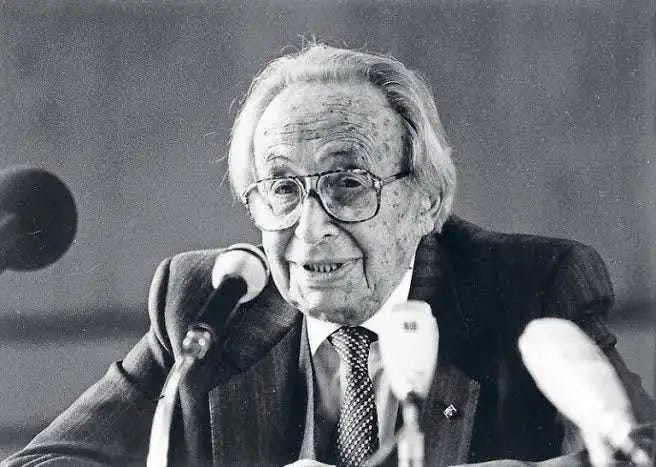
Hans Jonas, a practicing Jew, was born in Germany in 1903. He held a doctorate in philosophy and served in a Jewish brigade of the British Army during World War II. His mother died in Auschwitz. He emigrated to Canada and then to New York, where he died in 1993. I quote some paragraphs from my 2008 note on Jonas, found on pages 123 and 124 of Supervivir: Ideas para una ética universal
Discovering Hans Jonas made me both happy and unhappy. I found him online on June 15, 2006, mentioned by Francisco Fernández Buey. Later, I bought and enjoyed The Principle of Responsibility and The Principle of Life* Then came Power or Impotence of Subjectivity. These readings made me happy to find a man who strikes me as an excellent thinker, honest and prestigious, who believed in and preached the need for a new global ethic whose objective is the survival of the species. They made me unhappy to realize that Jonas worked tirelessly to try to justify, through reasoning and metaphysics, what needs no reasoning. I am certain that if he were alive today, given the advances in genetics and ethology, he would have started from the same premise: the imperative is inscribed in each and every human being, and the new ethic needs no justification. It needs the explanatory statement of the vital imperative, its acceptance, and its dissemination.
I am now going to quote some phrases from his most important book: The Imperative of Responsibility. Essay on an ethics for the Technological civilization. The book was published in German in 1979 and the first paragraph of the prologue states:
Definitely unleashed, Prometheus, to whom science provides unprecedented strength and economics an untiring impetus, is asking for an ethic that, through voluntary restraints, prevents his power from leading men to disaster.
And then:
The subjugation of nature, intended to bring happiness to humanity, has been so overwhelmingly successful—a success that now also affects human nature itself—that it has placed humankind before the greatest challenge it has ever faced through its own actions. All of this is new, unlike anything that came before, both in kind and in magnitude.
And then:
(…) this means that none of the ethical systems that have existed until now instruct us about the rules of “good” and “evil” to which entirely new forms of power and their possible creations must submit. The virgin territory of collective praxis into which high technology has led us is still, for ethical theory, a no-man’s-land.
And regarding the differences in ethics that have existed until now, it says between pages 27 and 31:
… before our time, man’s interventions in nature, as he himself saw them, were essentially superficial and incapable of damaging its permanent balance.
…actions on non-human objects did not constitute an area of ethical relevance.
…what had ethical relevance was the direct interaction of man with man, including interaction with oneself; all traditional ethics are anthropocentric.
…the entity “man” and his fundamental condition were seen as constant in his essence and not as an object of a transformative techne (art).
…The good and evil that the action was concerned with resided in the vicinity of the act (…) this proximity of the ends applies to both time and space. The effective scope of the action was limited.
All the commandments of inherited ethics are limited to the immediate environment of the action: “Love your neighbor as yourself”; “Do not do to others what you would not want them to do to you.”
And to summarize:
…No one was held responsible for the unforeseen consequences of their well-intentioned, well-thought-out, and well-executed actions. The short arm of human power did not require any long arm of predictive knowledge (…) Human good, known in its generality, is the same at all times; its realization or violation occurs at any moment, and its entire place is always the present.
He said this almost half a century ago. And we’re still in the same situation. The prevailing ethics remain the classic, group-based, and biased ones, applied by powerful leaders and those in positions of influence according to the criteria that suit their relativistic policies at any given time.
The new dimensions of responsibility
It emphasizes that, given the new situation created, it is necessary and urgent to rethink current ethics, their foundations, and the responsibility they entail, among other things:
The old precepts of proximate ethics—the precepts of justice, charity, honesty, etc.—remain valid (…) but the enormity of the new human forces imposes on ethics a new, never before dreamed of, dimension of responsibility.
The first change is the tremendous vulnerability of nature subjected to human technical intervention. We must take responsibility for the entire biosphere of the planet since we have power over it. Nature, as a human responsibility, is undoubtedly a new concept upon which ethical theory must reflect.
All traditional ethics relied on non-cumulative behaviors. But for the cumulative self-propagation of the world’s technological transformation, the lessons of experience are useless.
In such circumstances, knowledge becomes an urgent duty. No previous ethical framework has taken into account the global conditions of human life, the distant future, or even the very existence of the species. This demands a new conception of rights and duties.
If the new mode of human action meant that the biosphere, now subject to our power, had become a good entrusted to our care, a change of ideas in the foundations of ethics would be necessary. It would imply that we would have to seek not only the human good, but also the good of things beyond humanity. (p. 32)
Jonas, like many others, links the idea of human survival to the care of nature. He is right about that, but this dual objective meant that his basic idea of human survival, difficult to grasp and manage, was overshadowed by the more visible and easier-to-accept and marketable ideas of environmentalism and the risk of climate change. His work benefited some environmentalists, but no one paid attention to his warnings about the risk of humanity’s self-extinction and the duty to recognize it and act accordingly.
Something similar happened to the Oxford philosophers with their first objective about the future of humanity, who, unable to promote and apply this basic idea, dedicated themselves and continue to dedicate themselves to so-called “effective altruism”, taking care of the poor and nature.
I don’t need to emphasize that the goals of caring for nature and the poor are good goals, but they are partial goals that mask the main goal and, moreover, would serve as a framework for them.
Old and new imperatives
Jonas begins with Kant’s categorical imperative: “Act only according to that maxim whereby you can also will that it should become a universal law.” He proposes another imperative directed at the new type of agents of action: “Act in such a way that the effects of your action are compatible with the permanence of authentic human life on Earth”; or expressed negatively: “Act in such a way that the effects of your action are not destructive to the future possibility of that life”; or simply: “Do not endanger the conditions for the indefinite continuity of humanity on Earth.”
Jonas says that with the new imperative it is permissible for us to risk our lives, but it is not permissible for us to risk the life of humanity:
We have an obligation towards that which does not yet exist at all and which, in any case, insofar as it does not exist, has no right to demand existence. And he goes on to say: “This is not something easy to justify theoretically and is perhaps impossible to justify without religion.” (p. 38)
He then correctly asserts that the new imperative is directed more toward public policy than private behavior, since the latter does not constitute the causal dimension in which this imperative is applicable. The Kantian imperative was directed at the individual, and its criterion was instantaneous. The new imperative broadens both the temporal horizon and the collective it affects.
On the question of principles
Jonas raises two important questions here: What are the foundations of this new ethic demanded by the new type of action? And what are the prospects for the discipline it imposes becoming established in the practical affairs of men?
From page 63 to 141, the problem of foundation is raised, and different approaches are explored, but it is not resolved. And in the following pages, up to 160, the concepts of being and duty, and of good and value are analyzed, but this analysis also fails to provide a foundation for the new ethics.
The theory of responsibility: first ideas
As the DRAE (Dictionary of the Royal Spanish Academy) states, it first notes responsibility for the results of the acts committed and says:
a) Causal power is a condition of responsibility. The agent must answer for his act: he is considered responsible for the consequences of the act and, if necessary, held liable in the legal sense.
b) The earlier idea of compensation soon became intertwined with the idea of punishment, which has a moral dimension. In the case of a crime, the act itself is punished more than its consequences, and the sanction is measured by the act. Conspiracy to commit a crime is punished even if the crime is not carried out or is unsuccessful.
c) In both cases, responsibility is for doing or for thinking about doing. With this, it seems that: “In the absence of a positive duty, avoiding the act can become a prudential suggestion. In short, responsibility understood in this way does not set ends but is merely the formal burden that weighs on every causal action and that states that one can be held accountable for it. It is therefore the precondition of morality, but it is not itself morality.” (pp. 161, 162).
If I understand correctly, Jonas isn’t concerned with highlighting the moral responsibility for the negative effects on humanity of potentially harmful individual acts. I think he understands that these cases will already be punished without needing justification. If someone pollutes a river or sets a forest on fire, these acts are immediately considered wrong and therefore reprehensible and punishable, without needing to demonstrate that they are also harmful to the future of humanity. I think this is a gap in his work, but it’s understandable that he dedicates his efforts to the responsibility for what must be done.
Responsibility for what must be done: the duty of power
Jonas Says:
There is yet another entirely different concept of responsibility, one that does not concern the ex post facto bill to be paid for what has been done, but rather the determination of what must be done; according to this concept, I feel responsible primarily not for my behavior and its consequences, but for the thing that demands my action. (...) That for which I am responsible lies outside of me but is within the sphere of my power.
This is Jonas’s basic idea. The concept is clear and obvious. The problem lies in knowing what “the thing that demands my action” is. There may be many, but it’s about finding one that, for humans and according to their nature as living beings, is the highest vital good. The first and foremost objective. He says so on page 167 and following.
Natural responsibility: the first commandment
Responsibility instituted by nature, that is, the responsibility that exists by nature (an example is the responsibility of parents) does not depend on prior consent; it is an irrevocable, non-rescindable responsibility and it is a global responsibility.
Remember then that the existence of humanity is the first commandment and that:
The existence of humanity simply means that men live. And the next commandment is that they live well. The ontological fact of humanity’s existence in general becomes an ontological commandment for those who have not been asked about it before: the commandment that humanity must continue to exist. (p. 174)
…the duty to which we refer here only becomes apparent when its object is endangered. Before that, it would have been meaningless to speak of it. (…) Born of danger, it necessarily demands, first and foremost, an ethic of conservation, of protection, of prevention, and not of progress and improvement. (p. 230)
In these paragraphs, Jonas makes the basic idea clear: the responsibility and duty we humans have to ensure humanity’s continued existence. He also clarifies the main reason this mandate hasn’t been explicitly stated: it hasn’t needed to be stated because it has been fulfilled, with great biological success, by the same instinct that we humans, like all other living beings, possess.
In Chapter Three of the Report on Human Life, I outline some of the causes of the serious problem that has resulted from the lack of an explicit and operational understanding of this duty and responsibility of humankind. This problem persists despite the many voices in recent times, like Jonas’s, that warn of this mandate and the urgent need to “see” it and act accordingly, given the existing danger of self-extinction.
The danger of catastrophe and how to avoid it
He says the danger of catastrophe lies in the magnitude of economic and biological success: Economic success consisted of the increase, in quantity and variety, of the production of goods with greater expenditure by everyone within the system, which would entail the danger of the depletion of natural resources. “But that danger has been amplified and accelerated by a biological success: the exponential increase in population.”
This is the apocalyptic perspective that can be deduced from the dynamic path humanity is currently following. It is essential to understand that what we face is a dialectic of power that can only be overcome with greater power, not with a quietist renunciation of it.
He then asserts that this greater power must come from society, since no private understanding, responsibility, or fear is sufficient for such a task. And since the free market economy of Western societies is what causes this mortal danger… “the gaze naturally turns to the alternative of communism.”
And then:
It is clear that only a tremendously rigid and politically imposed social discipline is capable of bringing about the subordination of present advantage to the long-term mandate of the future.
He adds that since Marxism is also a form of progressivism, the opportunities it offers to avoid disaster must be examined within the framework of the trends it shares with modernity.
In the following chapters, he discusses at length who is best equipped to face the danger: Marxism or capitalism. He sees neither option as viable. He says it is necessary to abandon the utopian ideal of progress. He then points out the limits of nature, which he already considered serious at that time when the world population was 4.2 billion (p. 304). And he concludes with a final appeal for “A non-utopian ethic of responsibility.”
Linking to our December article on hope, I quote a few paragraphs from pages 356 and 358, where it says:
To the principle of hope we oppose not the principle of fear, but the principle of responsibility (…) Fear will become the first duty, the preliminary duty of an ethic of historical responsibility.
Closing remarks
Jonas’s extensive and well-founded work failed to gain the attention of leaders, both capitalist and communist, despite his fame and the widespread circulation of his book. Nor did he find any followers who would heed his call for human responsibility for the survival of humanity.
I think he was overly philosophical in his reasoning. The mandate is not one of human reason but biological. It is a vital imperative common to all living beings.
Nor did it take into account that the species chose widespread altruism as its primary means of survival. The choice of individual or group struggle as the main option, or the simple inability to live together in sufficiently large groups, led and continues to lead to the extinction of those who practiced it. As Arnold Gehlen (*) said, humans are “deficient beings” incapable of adapting to the environment through natural symbiosis. We need cultural institutions that can only develop through a form of coexistence that prioritizes altruism over struggle.
(*) L’Homme: His nature and his position in the world. Ed. Gallimard 2020
Or Darwin himself in The Descent of Man:
In his present, most imperfect state, man is always the most dominant animal of all those that have appeared on the surface of the earth… This immense superiority is undoubtedly due to his faculties, his social habits, which lead him to help and defend his fellow men, and the characteristic conformation of his body… The supreme importance of these characteristics has been demonstrated in the result of the struggle for existence.
The sense of responsibility for humanity’s survival cannot be imposed by force. It will develop when some of humanity’s moral leaders see, embrace, and disseminate the vital imperative, or universal ethical principle, that reinforces in people the sense of “being” fundamentally human before being Chinese or American. Humans whose life’s purpose is the survival of humanity. To strive to achieve this with the greatest possible well-being through the practice of broad altruism as a priority element of coexistence.
Addendum: The ethics of the spider
While researching background information on the ethics of responsibility, I came across this:
The Ethics of Responsibility (Spider-Man) In contemporary popular culture, the “spider ethic” is frequently associated with the superhero Spider-Man and his maxim: “With great power comes great responsibility.” (Wikipedia)

Then I saw that this idea, which confirms Jonas’s thesis on the responsibility and duty of those who can, is older. Wikipedia says:
With great power comes great responsibility, an ancient adage dating back to at least the 1st century BC, alluding to the sword of Damocles . The quote has been used in politics and monarchy, law enforcement and public safety, by journalists and authors, and in various media and memes. (Wikipedia)

The Spiderman reference also confirms altruism as a means. Wikipedia says:
Benevolent Responsibility: According to philosophical analyses (such as those based on Robert Spaemann), Peter Parker acts under an ethic of love and commitment towards others to mitigate suffering, even at the cost of his personal well-being.
But in reality, the spider’s ethics aren’t those of Spiderman, but rather those of the more than 46,000 existing species of the order Araneae discovered to date. Spiders, like us, are living beings. And like us, each one has the goal of ensuring the survival of its species. And, as we can see, many have succeeded. It seems that the first spiders appeared more than 400 million years ago. And that they perfected the system of making silk; first for use on land and about 110 million years ago for hunting in the air. This ability isn’t learned; it’s inherited according to the morphology of each species.
Spiders also use competition, deception, and altruism. He continues saying:
Parental care, or active attention to offspring, has been observed in various spiders. Wolf spiders carry their eggs, whether enclosed in a cocoon or not, and care for the young until they are developed enough to capture prey. There are some known cases of maternal suicide, in which the young spiders obtain their first nourishment from their mother’s body. Some spiders, such as the cosmopolitan genus Argyrodes (family Theridiidae), are kleptoparasites, stealing prey from other spiders by lying in wait in their webs. Kleptoparasitism has been observed in half a dozen families. Species of the genus Mycaria (family Gnaphosidae) mimic ants, not only in their appearance but also in their behavior, raising their front legs to the position of antennae. Sunpunna picta does the same, imitating the movements of a wasp.
And in some species, the females devour the male after mating.
As you can see, the spider’s ethics are very similar to human ethics. And vice versa. This is logical, since their basic objective is the same: the survival of the species with the greatest possible well-being.
Final note: Having clarified the vital responsibility preached by Jonas and the twofold foundation of the spider’s ethic (and our own), in a future article I will attempt to address those who may have the interest and capacity to see and assume this responsibility. According to Jonas, it seems that this responsibility belongs neither to capitalists nor communists. In my initial thoughts, which I will justify, I consider the following as possible recipients: the most needy people in the world, young people, Catholics, and all people of goodwill. Suggestions are welcome.
Happy New Year!!